From Martha to Michelle, America has had more than forty fabulous first ladies, as evidenced in
Our Country's First Ladies. This National Geographic book is full of interesting details from the lives of Martha Washington on down to Laura Bush (it was published in 2007). The book dedicates a spread to each First Lady in chronological order that includes a full page portrait and a perfect amount of well written copy. Learn about the influence these women had on their husbands, about the different causes they took on as well as lots of other interesting tidbits. For instance, did you know that Lou Hoover was the first woman to get a geology degree from Stanford University or that Elizabeth Monroe played a pivotal role in saving the wife of Marquis de Lafayette from the guillotine? You’ll also discover that Julia Grant once hosted a White House dinner featuring 29 courses of food and that 21 year old Frances Cleveland was the youngest First Lady. This book is a pleasurable read and an appropriate choice for this week’s theme....First Ladies!
Ages 9-12
◊◊◊◊◊
I notice that for the same aged reader, DK published a book in 2008 that includes our newest First Lady, Michelle Obama. It has been my experience that you can always count on these Eye Witness books to be fabulous. This one is titled
First Ladies
and it includes a clip art CD.
Many of you have gotten to know Abigail Adams through the amazing HBO miniseries,
John Adams. Following is an introduction to Abigail for the younger set....
TITLE:
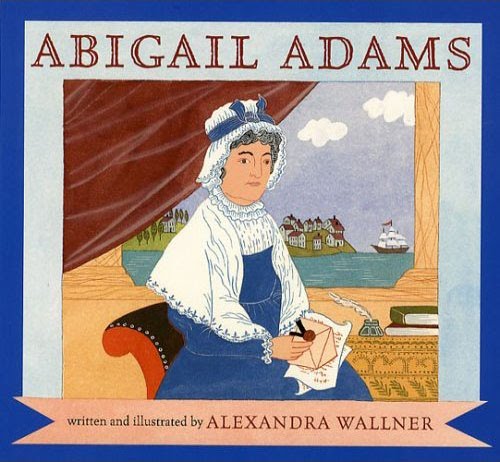
Abigail Adams
AUTHOR: Alexander Wallner
WHAT WAS HER BACKGROUND? The daughter of a reverend, Abigail was born in 1744 in Weymouth, Massachusetts near Boston. She was bright and wanted to attend school, but school was for boys in her mother’s opinion. So she spent a great deal of time in her father’s library reading and listening in on adult talk of current events.
HOW DID SHE AND THE FUTURE PRESIDENT MEET? When she was seventeen, she met the 26 year old lawyer, John Adams, who was a friend to her sister’s fiance. He was very impressed with her knowledge. They married a couple of years later.
ACCOMPLISHMENTS: She gave birth to six children. Of those, four reached adulthood and of those, one became the sixth president of the United States. She was often responsible for managing the family’s farm and finances while her husband traveled. She was directly effected by the brewing storm between the colonials and Britain. She boycotted goods that carried British taxes by making them herself, sheltered Boston residents who were fleeing the city after the Boston Tea Party and tried to influence her husband’s opinion regarding rights for slaves and women in the new laws he was helping to create. Unfortuanetly one reply he gave was “I cannot but laugh.” Believing strongly in education she sent her daughter to school and taught a black servant, who was not allowed to attend school, how to read and write.
Illustrated in a folk art style, this book is an excellent way to acquaint your child with a strong and bright woman who was present during our country's founding.
Ages: 4-8
◊◊◊◊
Activity: Color Abigail and John Adams


 Posts
Posts


 is a jewel of a book with drop dead gorgeous illustrations. Children will find parts of it sad. Loosing one’s freedom is always sad. But they will delight in Chee-Lin’s special relationships and their imaginations will be sparked by far away cultures in a long ago time.


 with Legos. This set for collectors is selling for upwards of $200! Or, for more feasible fun, try this
 is probably the only Spanish American War picture book in existence. In it, a black American shares a tall tale with his daughter about how he delivered a secret message to troops on the other side of Cuba. Some of his story is not true (GIANT snakes, and alligators and eagles, oh my!) but he does have a beautiful medal, so some of his story must be true.

 down. Then, when I read this story of a stray dog in Iraq connecting with an American soldier stationed there and of the great lengths they went to be together, I confess, I cried.


 (
(


 (
(


 is a beautifully illustrated introduction to the
 is a charming book to share with little ones. It is an introduction to the presidents depicted on Mount Rushmore (Washington, Lincoln, Jefferson and Teddy Roosevelt) in the guise of a school play. In fact, I wouldn't be surprised if it inspires children to put on their own presidential production. Introduces the election process and provides a little information on each of these four men.


 is
is 
 , it was during the Pleistocene. Her darling tale of Kip the cave boy and the first dog demonstrates to children how the human/canine relationship was mutually beneficial. Humans gained protection from the dog's keen hearing, smell and sight and the dog was rewarded with a dependable food supply. The book ends by incorporating a fascinating detail. Unlike wolves, dogs wag their tails.
