Showing posts with label Biography. Show all posts

Friday, July 29, 2011

When 2 Million Children Became Unemployed

Can’t get your kids to clean their room or take out the trash without grumbles galore? Maybe a session with this book will whip them into shape. Kids at Work: Lewis Hine and the Crusade Against Child Labor is a biography of Hines disguised as a 20th century photo documentary of how two million American children, some as young as three, where spending their long, dreary, hazardous days. It’s in fact brimming with his amazing photos of kids in coal mines, canneries, cotton fields and factories. I guarantee your child will be fascinated!

When we first purused this book, my daughter was about seven and still asking for me to peel her boiled shrimp. Then we saw the photo on page 42 of little four-year-old Mary who shucked two pots of oysters a day! Well, I was quick to point out, “Shannon, if little Mary could shuck all those oysters, you are certainly capable of peeling a few shrimp!” And she did.

It is a little eerie seeing eleven-year-old boys tend a blazing hot furnace with no adult supervision, so it may be crazy for me to say, but I can’t help but sense some pride in the faces of some of these capable children. Could twelve hour days have been scaled back to five hour weeks in lieu of cutting work out of children’s lives all together? Clobber me if you will, I'm just wondering. My son is 14 this summer and had high hopes of making money working at a marina near our house, but because of the child labor laws, he can’t be considered for employment until he is 16. My boy grew up around boats and helped bring a boat from the Bahamas to Florida in rough seas when one of the two adults on board was laid up with a bad back. He's earned his boating license, has several hours of flying time and scuba dives. He is quite capable of fueling a vessel, tying a line and helping passengers get their supplies on and off boats...but now he has to wait two more years in order to be paid for it.

On another note, we have a fig tree in our yard. It produced vast quantities of figs this year. My eleven-year-old daughter and her friends scrambled for every opportunity they could get to pick the fruit...because they loved doing it. I’ve heard that Georgia farmers were having a hard time finding fruit pickers this year because the state has scared illegal immigrants away. Why aren’t high school and college kids stepping in to fill the void? I remember my father’s tales of picking apples in upstate New York when he was a kid looking for a buck.

Well, I think Kids at Work will be a great conversation starter at your house too. The book sums it up this way:  “Hine’s images of working children stirred America’s conscience and helped change the nation’s laws. With his box camera and his sympathetic eye, he made a dramatic difference in people’s lives. In a real sense, the face of America never looked the same again.”

Ages 6 and up
◊◊◊◊◊

Activity: For goodness sakes, learn how to peel your own shrimp:


Tuesday, January 25, 2011

Great Heights Week - Tallest Man


And I thought I stood out like a sore thumb in high school! (I’m 5'10"ish)


My children and I were captivated when we recently read about the tallest man ever in Jennifer Phillips’ book, Robert Wadlow: The Unique Life of the Boy Who Became the World’s Tallest Man. He was the size of an adult by age five and eventually grew to the incredible height of 8'11.1"! You’ll learn of the accommodations he had to make, that an overactive pituitary gland caused his condition and to see Robert, not as an oddity, but as a person—and a likable one at that. A discussion about fitting in with one’s peers would complement this story nicely.

Besides fascinating photographs, the author also includes a fact page, a timeline and thoughtful questions to explore as well as suggested activities.

Ages 9-12
◊◊◊◊

A review of Stand Straight Ella Kate caught my eye over at the Palnetsme Plan blog recently. This looks like a great choice for all of us tall girls.
Activity: Print out Robert Wadlow’s shoe print and compare it to your own foot size.

Thursday, January 6, 2011

Gutenberg — The Inventor of Printing


How long does it take to print a book? For Johanne Gutenberg it took more than 30 years! What was the hold up? Well, since it had never been done before he had a lot of problems to work out. Many were related to the invention itself: finding the right metal formula for the type, making an ink that wasn’t too runny or too sticky, figuring out how to space the letters and get them consistently raised off the slug and the designing and building of the press itself. His other problems involved money. He dealt with lawsuits, partnerships gone awry, denied inheritances and fund raising opportunities lost (something to do with selling souvenirs to pilgrims traveling to see remnants of the clothes of Christ).

Fine Print takes you on a fascinating look at the man who was determined to invent mass–produced printing and persevered. It’s a wonderful lesson in persistence and a very interesting glimpse into 15th Century Germany.

Ages 9-12
◊◊◊◊◊

Activity: Cut a letter in a potato and then print it:


Okay, this involves a knife, so some parental involvement is probably necessary.  Cut a medium sized red potato in half, then cut away anything that you don’t want to print. Remember, you have to create your letter backwards on your stamp.


Now put some ink or paint on your stamp and press. Viola!

Thursday, September 2, 2010

BEACH WEEK - Fossil Finder


TITLE: Mary Anning and the Sea Dragon

AUTHOR: Jennine Atkins

WHO WAS AT THE BEACH? Mary Anning, paleontologist extraordinaire, before paleontology was cool (or even actually thought of).

WHAT BEACH AND WHEN? In Lyme Regis, England in 1810, eleven year old Mary Anning made an amazing discovery!

WHAT HAPPENED? Mary was born to a struggling family. Her father was a cabinetmaker by trade, but collected fossils from the cliffs on the beach to sell to tourists. Mary was his frequent companion in this endeavor. Then when she was eleven he died, leaving the Annings even more destitute. Mary continued hunting for “curiousities” to help provide for her family. Soon after her father’s death she was the first person to ever uncover an ichthyosaur.  She went on to make other important discoveries, most notably the first plesiosaur.

An inspiring tale of an amazing individual. I highly recommend this book.

Ages 9-12
◊◊◊◊◊

Activity: Mary was uncovering fossils from the Jurassic period. Can you match the picture of the Jurassic creature with it’s name?


Wednesday, September 1, 2010

BEACH WEEK - Captain Kidd


TITLE:  Captain Kidd: Seventeenth-Century Pirate of the Indian Ocean and African Coast

AUTHOR: Aileen Weintraub

WHO WAS AT THE BEACH? Captain Kidd, a privateer turned pirate.

WHAT BEACH AND WHEN? On his way to New York City in 1699 to see his wife and daughters after three years at sea, Captain Kidd purportedly stopped at Gardiners Island on Long Island, New York to bury his treasure.

WHAT HAPPENED? Raised by a Presbyterian minister in Scotland, Kidd was hired in 1689 by the British to plunder enemy ships (especially those belonging to those dang French!) On one voyage his full crew was working under the “No Purchase, No Pay” agreement. This meant that if they didn't capture a ship, the crew wouldn't get paid. Ships to plunder were scarce, Kidd chickened out of capturing a couple they sailed near, the crew was getting restless to say the least, and then, out of desperation, Kidd attacked a (gasp) British ship. His badness pretty much spiraled out of control after that, and he willy nilly attacked ship after ship. He knew he was branded a pirate when he buried that treasure on Long Island, and hoped that he could use it as a bargaining chip in negotiations to avoid punishment. But, alas, he was hung in London in 1701 where his body was on display for years (geez!), and as for his treasure? It remains a mystery.

Ages 9 to 12
◊◊◊◊

You also might like this DVD produced by the History Channel, Investigating History - Captain Kidd.

Activity: Bury a treasure for your kids to find. Purchase a treasure chest from a craft store, shell shop or import store. Fill it with colored stones, costume jewelry, old or foreign coins, marbles, shells, sea glass and skeleton keys. Bury it and then use brown ink to draw a map to it on this old piece of paper you can print out. The paper is made available by http://ayelie-stock.deviantart.com/art. Once they have practice finding your buried treasure, then maybe they can tackle finding Captain Kidd's!

Tuesday, August 31, 2010

BEACH WEEK - Surfer of the Century


TITLE: Surfer of the Century

AUTHOR: Ellie Crowe

WHO WAS AT THE BEACH? Duke Kahanamohi, a beachboy turned Olympian.

WHAT BEACH AND WHEN? Duke spent most of his time at Waikiki Beach in Hawaii perfecting his surfing and swimming in the early 20th century.

WHAT HAPPENED? When a local lawyer with an interest in swimming noticed how fast Duke cut through the water, he got involved in getting Duke into competitive races. Duke eventually won his first gold medal in Stockholm, Sweden in the 1912 Olympics. His interesting life included breaking many swimming records, along with some color barriers, a friendship with fellow Olympian and native American, Jim Thorpe and winning several Olympic medals for the U.S.A. team. He also developed the flutter kick, helped coach the Australian Olympic swim team, built his own surf boards, introduced surfing to Australia and the mainland of America, surfed for nearly two miles on a monster wave that was 30 feet high, acted in a couple of Hollywood movies, rescued eight people from a sinking boat via his surfboard, and served as sheriff of Honolulu. No wonder this guy is considered a legend!

Surfer of the Century is a beautifully illustrated tribute to Duke Kahanamohi.

Ages 9-12
◊◊◊◊

Activity: How fast can you swim the 100 meter freestyle? Duke’s fastest race time is recorded at 60.4 seconds. Can you beat that?

Monday, August 30, 2010

BEACH WEEK - First Flight


I've been so busy enjoying the beach and so many other fun activities this summer that my blogging has ebbed. To make up for it I’m offering a flood of history that has happened at the beach...

TITLE: Will and Orv

AUTHOR: Walter A. Schulz

WHO WAS AT THE BEACH? This book details the day of the Wright Brother’s first flight through the eyes of Johnny Moore, a young Outer Banks native, who was, in fact, a witness to this historic event.

WHAT BEACH AND WHEN? The Wright Brother’s chose Kitty Hawk, North Carolina to test their flying machines because the wind blew everyday, the sand made for a soft landing and there were no trees or rocks to run into. Their first successful flight occurred on December 17, 1903.

WHAT HAPPENED? Johnny had gotten to know the Wright Brothers over the three summers they had come to Kitty Hawk to test their flying machines. In 1903 they stayed beyond summer to test their big glider with a motor they called the “Flyer.” The author tells the story of this historical day from the perspective of Johnny, starting with him leaving his house in the morning and ending with him celebrating the first successful flight later that day.

Your child will gain knowledge about not only the motor and propellers, but also the relationship between the Wrights and the locals, who often helped them. This book also drives home the point that the Wright Brothers developed the first method to enable an engine powered aircraft to go up, down and turn all with the Wrights own hand-made parts. These and other details are offered in a nicely paced little story that was first published in 1991, but has the charming qualities of one from the 1950’s.

Ages 4-8
◊◊◊◊◊

Activity: If you have money to spare and lots of patience, make a replica of the Wright Brothers Plane with Legos. This set for collectors is selling for upwards of $200! Or, for more feasible fun, try this Wright Brothers coloring page from another post.

Wednesday, June 23, 2010

Bad News for Outlaws


Everything about Bass Reeves was big: his shoulders, his hands, his hat, his horse, his mustache and his reputation for being a sure shot. But the biggest thing about him was his character. Vaunda Micheaux Nelson does an exemplary job of introducing this Texas born slave turned free man who fought for justice. In Bad News for Outlaws: The Remarkable Life of Bass Reeves, Deputy U. S. Marshal, she chronicles how Reeves went about outwitting outlaws from 1875 to 1907. In that time he brought in over 3,000 bad guys, sometimes as many as 17 at once! Sadly, his own son was one of those 3,000. The tone of the telling puts you in an old west frame of mind and the illustrations are as right as rain. It was fun to find this forgotten hero. 

Ages: 9-12
◊◊◊◊

Activity: You may be wondering, what do U.S. Marshals do? They apprehend more than half of all federal fugitives, protect the federal judiciary, operate the Witness Security Program, transport federal prisoners, conduct body searches, enforce court orders and Attorney General orders involving civil disturbances and acts of terrorism, execute civil and criminal processes, and seize property acquired by criminals through illegal activities. 

Are you interested in becoming a U. S Marshal like Bass Reeves? Today you would have to meet these qualifications: be a U.S. citizen between the ages of 21 and 36, have a bachelor’s degree or three years of qualifying experience, have a good driving record and valid driver's license, complete a structured interview, meet medical qualifications, undergo a rigorous 17 1/2 week basic training program and be in excellent physical condition. Here are links to the fitness standards for men and the fitness standards for women. Can you do 33 push-ups, 40 sit-ups and run a mile and a half in 12:18? If so, you may well be on your way to being a U. S. Marshall. You can look here for more information.

Friday, May 7, 2010

FIRST LADY WEEK: Martha Washington

TITLE: Martha Washington: America's First Lady

AUTHOR: Jean Brown Wagoner

WHAT WAS HER BACKGROUND? Martha Dandridge, who was called Patsy by her family, was the oldest of eight children. She grew up on a Virginia plantation and spent her days sewing, riding, reading and playing with her siblings, cousins and even a pet bear cub. This book portrays a positive relationship between young Martha and all the people in her life, including the house slaves. Her’s was an isolated existence with little travel beyond the borders of the plantation, so the highlight of the year was the arrival of a supply ship that anchored near her home. This was a cause for great celebration as guests came from miles around for feasts, dances, horse races and fox hunts.

HOW DID SHE AND THE FUTURE PRESIDENT MEET? Martha lost two children and her first husband to illness and was managing a plantation alone. She was visiting friends who lived on a river near a ferry crossing. Her host noticed George Washington on the ferry and hurried out to invite him to dinner. Washington was already a French and Indian War hero and was commander in chief of the armies of Virginia.

ACCOMPLISHMENTS: She was capable at a wide array of skills, from riding a horse to weaving cloth and sewing clothes. She had four children from her first marriage. Of these, two survived into early adulthood and made her a grandmother. She visited George Washington at Valley Forge and aided the sick, the hungry and the needy. After seeing that these men hardly had enough clothes to cover themselves she kept fifteen spinning wheels going day and night at Mount Vernon and pleaded with friends to also make cloth for the soldiers’ clothes.

Ages: 9-12
◊◊◊◊

This was a pleasant way to learn about Martha Washington. I was glad to discover that this book is in a Childhood of Famous Americans series that contains nearly 50 titles. What a great way for children to relate to those who have made history! Other titles in the series include:  Milton Hershey: Young Chocolatier, Albert Einstein: Young Thinker, Crazy Horse: Young War Chief and Paul Revere: Boston Patriot.

Activity: Martha Washington had an unusual childhood pet. Can you match these out-of-the-ordinary pets with one of the following first families?


Thomas Jefferson, John Quincy Adams, Abraham Lincoln, Theodore Roosevelt, Woodrow Wilson, Calvin Coolidge or Hubert Hoover

A.
    Silk Worms
B.     Opposum
C.     Racoon
D.     Mockingbird
E.     Badger
F.     Ram
G.    Turkey


You also might want to check out this interesting resource on presidential pets.

Thursday, May 6, 2010

FIRST LADY WEEK - Ladybird Johnson

TITLE: Miss Lady Bird's Wildflowers: How a First Lady Changed America

AUTHOR: Kathi Appelt

WHAT WAS HER BACKGROUND? Claudia Alta Taylor whom we know as Lady Bird Johnson, was born in Karnack, in eastern Texas in 1912. Her nanny proclaimed one day, “She’s as purty as a ladybird,” and the name stuck. A ladybird is another name for a ladybug. She had an enchanted, well-to-do though isolated childhood. Her mother died when she was only five. An aunt came to help raise her, and it is she who inspired Lady Bird to appreciate nature's beauty. Lady Bird enrolled in the University of Texas in 1930, at a time when it was unusual for women to attend college, and earned a degree in journalism.

HOW DID SHE AND THE FUTURE PRESIDENT MEET? While she was attending the university in Austin she met Lyndon Baines Johnson who was working as a congressional aid. He proposed on their first date.


ACCOMPLISHMENTS: She had two daughters, Lynda and Luci. She introduced them to gardening but worried about other children playing in concrete parks and having no connection to growing plants. When her husband became president she poured her energy into the Highway Beautification Act. Highway landscapes changed because of that law. Road signs and depreis were better managed and native wildfloweres were planted. Later, when she was seventy, she helped establish the National Wildflower Research Center.

Illustrations filled with rich and vivid colors compliment the copy. This would make a great gift for the child with an interest in flowers.
Ages 9-12
◊◊◊◊

Activity: Here’s a great mother’s day gift idea. Print out this seed packet template, color it, glue up the sides and fill it with seeds. Your mother will love it!

Monday, May 3, 2010

FIRST LADY WEEK - Abigail Adams

From Martha to Michelle, America has had more than forty fabulous first ladies, as evidenced in Our Country's First Ladies. This National Geographic book is full of interesting details from the lives of Martha Washington on down to Laura Bush (it was published in 2007). The book dedicates a spread to each First Lady in chronological order that includes a full page portrait and a perfect amount of well written copy. Learn about the influence these women had on their husbands, about the different causes they took on as well as lots of other interesting tidbits. For instance, did you know that Lou Hoover was the first woman to get a geology degree from Stanford University or that Elizabeth Monroe played a pivotal role in saving the wife of Marquis de Lafayette from the guillotine? You’ll also discover that Julia Grant once hosted a White House dinner featuring 29 courses of food and that 21 year old Frances Cleveland was the youngest First Lady. This book is a pleasurable read and an appropriate choice for this week’s theme....First Ladies!

Ages 9-12
◊◊◊◊◊

I notice that for the same aged reader, DK published a book in 2008 that includes our newest First Lady, Michelle Obama. It has been my experience that you can always count on these Eye Witness books to be fabulous. This one is titled First Ladies and it includes a clip art CD.

Many of you have gotten to know Abigail Adams through the amazing HBO miniseries, John Adams. Following is an introduction to Abigail for the younger set....


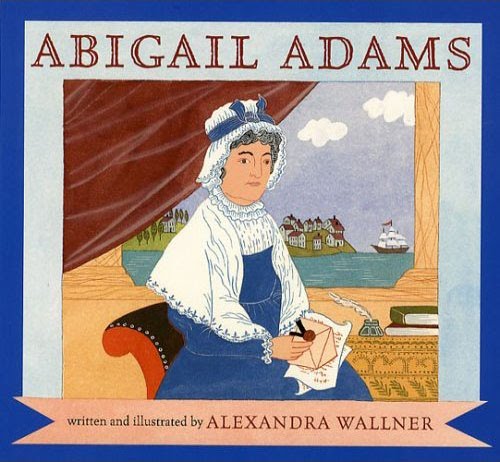
TITLE: Abigail Adams

AUTHOR: Alexander Wallner

WHAT WAS HER BACKGROUND? The daughter of a reverend, Abigail was born in 1744 in Weymouth, Massachusetts near Boston. She was bright and wanted to attend school, but school was for boys in her mother’s opinion. So she spent a great deal of time in her father’s library reading and listening in on adult talk of current events.

HOW DID SHE AND THE FUTURE PRESIDENT MEET? When she was seventeen, she met the 26 year old lawyer, John Adams, who was a friend to her sister’s fiance. He was very impressed with her knowledge. They married a couple of years later.

ACCOMPLISHMENTS: She gave birth to six children. Of those, four reached adulthood and of those, one became the sixth president of the United States. She was often responsible for managing the family’s farm and finances while her husband traveled. She was directly effected by the brewing storm between the colonials and Britain. She boycotted goods that carried British taxes by making them herself, sheltered Boston residents who were fleeing the city after the Boston Tea Party and tried to influence her husband’s opinion regarding rights for slaves and women in the new laws he was helping to create. Unfortuanetly one reply he gave was “I cannot but laugh.” Believing strongly in education she sent her daughter to school and taught a black servant, who was not allowed to attend school, how to read and write.

Illustrated in a folk art style, this book is an excellent way to acquaint your child with a strong and bright woman who was present during our country's founding.

Ages: 4-8
◊◊◊◊

Activity: Color Abigail and John Adams

Tuesday, April 27, 2010

Learning to Read While Learning History


This is what I was reading in 1st grade:

Given the choice, I would rather have been reading this:


Today we are bombarded with more choices than ever, whether we are in the shoe store, on the car lot or in the cereal aisle. In my day everyone was wearing saddle shoes, driving station wagons, eating Wheaties for breakfast and, of course, learning to read with Dick and Jane. Well, happily, that whole variety of options thing has carried over to beginning readers! Step Into Reading offers a batch of entertaining and educational titles on five levels. Step 1: ready to read (preschool to kindergarten), Step 2: reading with help (preschool to 1st grade), Step 3: reading on your own (1st to 3rd grade), Step 4: reading paragraphs (2nd to 3rd grade), Step 5: reading chapters (2nd to 4th grade).

Step 3 is a collection of over seventy books about nature, action heroes, princesses, witches, folk tales and familiar characters like Arthur. And I'm drooling over all the history titles available at this beginning reader level. Here they are: